Body Language During a Presentation: What to Do With Your Hands?
Wondering what to do with your hands on stage or on camera? Calm body language during a presentation builds trust. Discover proven exercises.
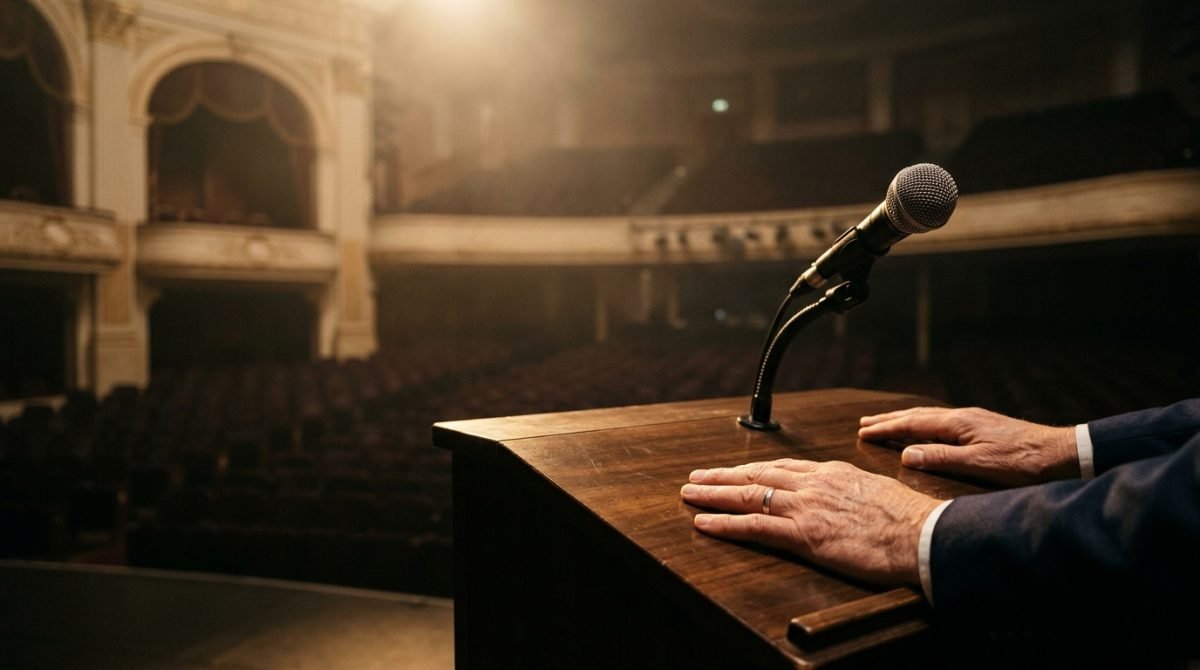
It is a Saturday morning. You are drinking coffee and structuring the autumn annual summaries in your head, which you will soon present to the board. You get up from the table to practice the first sentences out loud, and suddenly a problem arises. Your hands start to weigh a ton. You don't know whether to put them in your pockets, cross them over your chest, or let them hang by your sides. The answer to the question of what to do with them is simple: let them rest in a base position, and at the right moment, they will naturally follow your voice. Body language during a presentation cannot stand artificiality, and a forced gesture always misses the rhythm of the words.
Before you stand in front of people
Before you start positioning your hands, you need to take care of the foundation. On a television set, I often see how tension from the legs transfers straight to the shoulders, blocking natural gestures. Many of my guests breathe shallowly, using only the top of their chest, right before going on air. This immediately stiffens the neck and shoulders. It is hard to move your hands freely when your whole body is locked up with stress. Preparing your posture begins with contact with the ground.
- Stand with your feet slightly apart, distribute your body weight evenly on both legs, and feel the stability.
- Straighten your back, pulling the top of your head toward the ceiling, but do not puff out your chest like you are on parade.
- Drop your shoulders freely, letting them fall under their own weight.
- Position your head so your gaze naturally falls on the eye line of your audience or into the lens axis.
- Take a deep diaphragmatic breath, allowing your stomach to rise gently, and relax your neck as you exhale.
When your posture is stable, your hands stop looking for a point of support. You no longer have to nervously grip the edge of the lectern or clench your fingers on the back of a chair. Only on such prepared ground can you start consciously working with gestures.
Body language during a presentation in three steps
Calm body language during a presentation relies on rhythm and purpose. You do not have to wave your hands around for the entire duration of the presentation. It is enough to master three phases of movement that organize the visual message.
First, find your base position. This is a safe place where your hands return when you are not emphasizing anything. A loose clasp of the hands at navel height, the so-called basket, works best. The fingers overlap freely, without clenching. Another option is to let your hands hang loosely by your sides. It is important that your elbows are slightly away from your torso, which optically broadens your silhouette and adds confidence.
Second, gesture only when the content requires it. Hand movement should emphasize the main sentence stress. If you are talking about revenue growth, your hand can go up. If you are listing three key arguments, show them on your fingers. Open hands with palms facing up build a connection and show sincerity. Avoid pointing with your index finger; replace it with a gesture of the whole open hand. A gesture is meant to support the word, give it weight, and not compete with it.
Third, return to the base. When you finish a thought, put a period at the end of a sentence, or take a longer pause, let your hands drop back into the basket. This gives the audience a clear signal that a given topic has been closed. Stopping the movement builds authority much more effectively than constant, nervous waving in the air.
The most common mistakes
During on-camera training, I regularly observe a few habits that effectively distract from the substance. The body always reveals the level of tension, so eliminating these mistakes is essential.
The fig leaf. Hands clasped tightly at the crotch, shoulders dropped. Such a posture closes the chest and sends a signal of a desire to defend or deep discomfort. The fix: raise your hands higher, to waist level, and loosen the clasp of your fingers.
T-Rex syndrome. Elbows glued tightly to the ribs, only the forearms and hands are working. Movements become nervous, short, and angular. The fix: detach your elbows from your torso, give your armpits some space. The gesture must flow smoothly from the shoulder to look natural and take up the right amount of space in the frame or on stage.
Hands in pockets. While one hand in a pocket during a casual anecdote can look nonchalant, both hands hidden deep throughout the entire presentation is a mistake. You show distance this way or try to hide shaking hands. The fix: take your hands out, rest them on the base, and show your hands to the audience.
Toys in hands. Clicking a pen, spinning a wedding ring, crumpling the corner of your notes. This is visual noise that hypnotizes the audience in the worst possible way. The fix: put everything down on the table. Public speaking skills: message construction, opening, punchline, and managing stage fright are a craft that requires a clean form. Empty hands show that you have full control over the situation.
How to practice this
You can start working on your gestures today, in your own home. Spread this process over a few days so your body has time to absorb the new habits.
On Monday and Tuesday, speak to a mirror. Focus exclusively on the base position. Read a fragment of an article out loud and check if your shoulders are dropped and your hands are resting calmly at waist level. Do not add any gestures yet; simply teach your body calmness.
On Wednesday and Thursday, turn on the recording on your phone. Prop it up against some books, stand a meter away. Talk about your day or weekend plans, consciously using your hands to emphasize the most important words. Watch the footage without sound. You will then see clearly whether your gestures make sense, whether they support the content, and whether you are making empty movements.
On Friday, combine both things. Record a short introduction to your board presentation. Start from the base, make a specific gesture at a key argument, and consciously return to the starting point for the pause.
A phone and a mirror are a great start to getting used to your own body. However, when you feel that home methods are no longer enough and your progress is slowing down, it is time for verification in professional conditions. I will be honest: studio training makes a difference. Working with three cameras, in studio lighting, with a broadcast microphone exposes every uncertain movement. Recording right at the start, analyzing the footage sentence by sentence with the director on set, and repeating the take until it starts working out allows you to build solid muscle memory. You always take your recordings from such a training session to see real progress.
Your hands on stage are not your enemy, but a tool that makes it easier to receive the content. When you stop thinking about them compulsively and master returning to the base, they will become a natural extension of your voice.
Questions and answers
Should gestures be the same in every presentation?
No, the dynamics of gestures depend on the topic and the size of the room. On a large stage, movements must be broader, while on camera or in a small conference room, sparing hand movements are enough.
What should I do if my hands start shaking during a presentation?
Rest your hands on the lectern or clasp them a bit tighter in the base position at waist level. Take a deep diaphragmatic breath during a pause, which will physiologically lower your tension level.
Is holding notes in my hand a mistake?
It is definitely better to have your hands free so you can use them naturally and build a connection with the audience. If you must use prompts, place the papers on a table or use small, discreet flashcards.