Corporate podcast: how to speak to camera and prepare a guest
Hosting a corporate video podcast? See how to speak to the camera during an interview, frame the shot, and prepare your guest for a natural conversation.
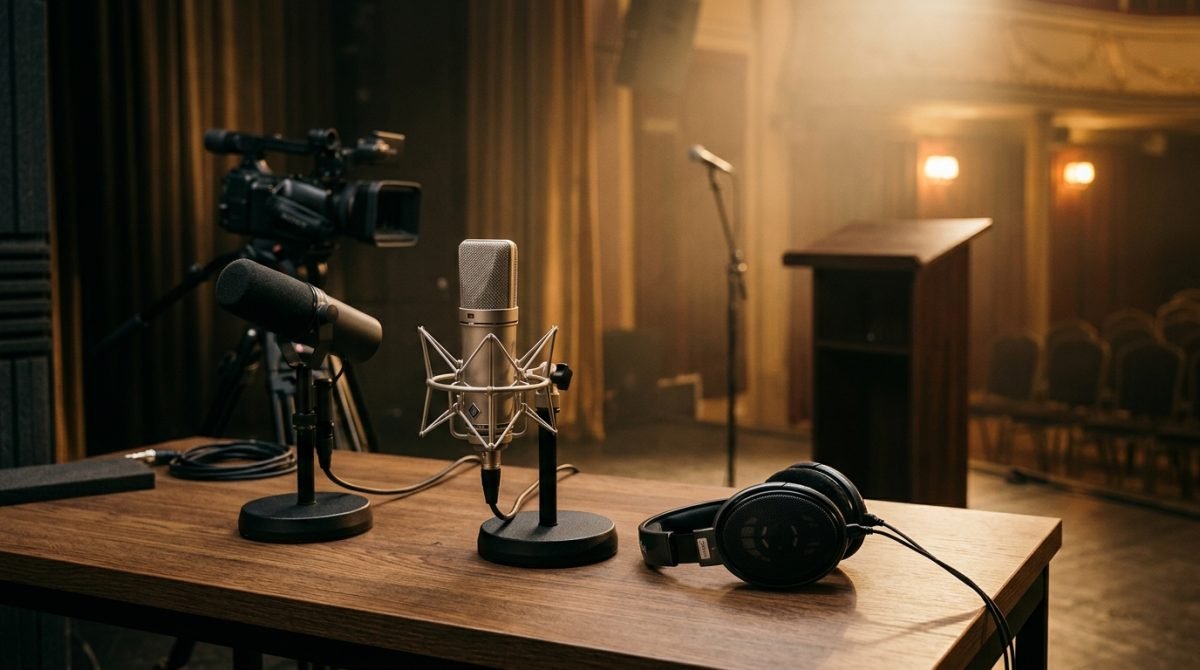
Tuesday morning, a typical autumn outside the window, and in the studio we are recording another episode of a video format for the management board, which will soon summarize the annual results for the employees. You wonder how to speak to the camera when a guest sits across from you, surrounded by tripods, microphones, and lights. The answer comes down to treating the lens as a third participant in the conversation, not an intruder. It is an attention management skill that can be broken down into simple, mechanical steps.
Before you face the audience
A good interview starts long before you hit record. When you host a corporate podcast, your guest is rarely a media personality. It is usually an expert, director, or engineer who has immense substantive knowledge, but the sight of a red light on the camera paralyzes them. Your job is to take this burden off them. Preparing the space and the person is the foundation that will determine the dynamics of the entire conversation.
- Establish a common axis of eye contact by telling the guest directly that they are talking to you, not the equipment.
- Ensure the physical arrangement of the armchairs is at a slight angle, the so-called opening to the camera, which makes the shot look better and allows you to talk more freely.
- Ditch writing questions word for word in favor of short bullet points, so that reading from a piece of paper does not kill the naturalness.
- Do a quick vocal and breathing warm-up, using a few deep diaphragmatic breaths and loose lip trills.
- Inform the guest about the structure of the conversation so they know how you will start and when it will end.
How to speak to the camera during an interview
In a video interview format, you have two vectors of attention. The first is your interlocutor, the second is the viewer on the other side of the lens. When you host a program, you must smoothly manage this triangle. It is like driving a car, where you glance in the mirrors, but keep your main focus on the road.
For the greeting and farewell, look straight into the center of the lens. This is the moment when you build a direct relationship with the audience and invite them into your world. When you ask a question, your gaze wanders to the guest. You maintain this contact throughout their entire statement. The viewer observes your interaction from the side. If the guest is speaking and you are looking at your notes, the preview monitor, or your watch, you send a signal of disinterest. The body does not lie.
In my training sessions in a Warsaw studio, where we work with three cameras, a teleprompter, and broadcast equipment, I often see this breakthrough moment. The participant realizes that the lens is simply the viewer's eye. Once you understand this, you stop playing the presenter and start talking normally. If you want to add something directly to the viewers during the guest's statement, take a pause, turn your head to the main camera, say one sentence, and return your gaze to the expert. Such a move makes the format more dynamic and shows that you are fully in control of the situation.
Most common mistakes
Working on set quickly verifies habits. Specific stumbles repeat in video interviews, which are easy to eliminate once you calmly realize them.
Windshield wiper syndrome. The host nervously shifts their gaze between the guest, the camera, and the notes on their lap. The audience feels anxious and stops focusing on the content. The fix is to keep your eyes on one point for longer. If you are looking at the guest, stay there until the end of their thought. Eye movements must be intentional.
Stone face listener. You focus on the next question so much that your face stiffens. You look like a strict judge, not a curious host. The fix is to consciously react with facial expressions. Nod, smile, frown when something is unclear. Active listening is much more visible in the frame than live in a conference room.
Breaking the silence at all costs. The guest finishes a sentence, and you immediately jump in with the next question, not letting their words resonate. The fix requires accepting the pause. Two seconds of silence in a video is a space for viewer reflection, not a technical error.
Overly stiff posture. You sit deep in the armchair, resting your back against the backrest. The voice loses support, and you look resigned. The fix is to move to the front edge of the chair. You rest your feet flat on the floor, your back is straight, your chest is open. This gives the diaphragm room to work.
How to practice this
Working with a camera requires muscle memory. You can train this in your own home, without a production crew and expensive equipment. Plan a simple process for the coming days to get used to your own image.
On Monday, set your phone on a tripod at eye level. Sit a household member across from you or place any large object on a chair. Record a two-minute greeting where you look into the phone lens, and then smoothly turn your head and move on to asking your interlocutor a question. Watch the footage without sound. Check if your eyes do not dart to the sides when changing the direction of your gaze.
On Wednesday, practice active listening. Turn on any interview on YouTube. Imagine that you are the host. Listen to the guest and react to their words with facial expressions. See how many natural head and face movements you make when you are truly trying to understand another person. Transfer this behavior to your next recording.
On Thursday, focus on posture. Sit on the edge of a chair in front of a mirror and read any text out loud. Feel how your abdominal muscles work when you do not lean against the backrest.
On Friday, do a notes test. Write three questions in the form of full sentences and try to read them in front of a mirror, pretending to have a conversation. Then change them into three single keywords. You will see how much easier it is to maintain eye contact when you do not have to read entire lines of text. Only when you master these basics in home conditions will working in a studio with a director and frame-by-frame footage analysis bring a full, noticeable effect.
The camera exposes a lack of attention, but it can also reward genuine interest in another person. When you fully focus on your interlocutor, the technology around you will stop mattering, and the viewer will feel like part of your discussion.
Questions and answers
Where should you look when a guest gives a long answer?
Maintain eye contact with the guest. Looking at the camera while they speak makes the viewer perceive you as bored or impatient.
What should I do if I make a mistake while reading an intro?
Take a short pause, take a calm breath, and repeat the entire sentence from the beginning. It is easy to remove silence in editing, but hard to cut out a stutter mid-word.
Should the guest look into the lens?
No, in a classic interview, the guest looks only at the host. When an expert addresses the camera directly, it breaks the illusion of a natural conversation.