How to Speak to the Camera for Hours: A Set Plan
Fall is a time for summaries. Learn how to speak to the camera for hours without losing your breath or voice. Discover recording studio techniques.
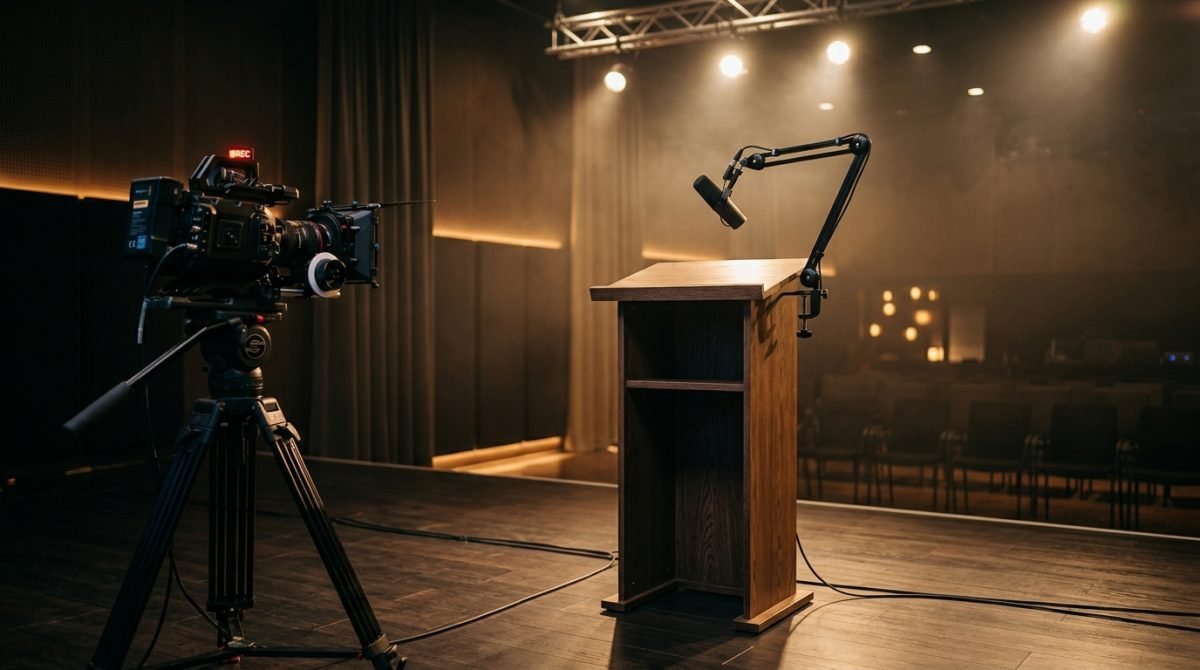
Friday morning, I walk into the recording studio, and dozens of pages of text are waiting on the teleprompter. Fall is the season for intensive annual summaries and presenting results to boards of directors, which often means long hours in front of the lens. If you are wondering how to speak to the camera for several hours without losing your voice or concentration, the answer comes down to energy economy and properly dividing the material. This is a craft that requires physical preparation.
Before you stand in front of people
In the studio, even if you are alone with the camera operator, you are ultimately speaking to the viewers. Before you stand in front of people, you need to plan your shoot day so you do not burn out in the first hour. Working on set is a marathon, not a sprint. Fatigue shows first in the eyes and is heard in a slowing speaking pace. Preparation is the foundation.
- Divide the text into blocks. Do not read the whole thing in one go. Divide the material into fragments of a dozen or so sentences. This keeps you fresh and makes later editing easier.
- Plan water breaks. Your throat dries out faster than you think, especially under warm studio lights. Always keep a glass of still water handy.
- Warm up your vocal apparatus. Before we start recording, hum, do lip trills, massage your cheeks, and relax your jaw. This relieves tension from your facial muscles.
- Prepare comfortable shoes. Even if the frame only covers you from the waist up, how you stand affects your breathing and neck tension. A stiff posture quickly translates to a stiff voice.
- Eat a light meal. Working on camera burns a lot of calories, but a heavy lunch will drain your energy. Eat something light an hour before going on set.
Step by step: how to speak to the camera all day
When the red light is on for several hours, your body starts to cheat. You start speaking faster to get it over with, or you lose strength and your voice loses its resonance. To avoid this, stick to a steady work rhythm.
First, control your breathing. Take air in low, into your lower ribs, without raising your shoulders. Shallow breathing from the chest will give you a hoarse voice after two hours, and your sentences will become choppy. Deep breathing is the foundation of voice work.
Second, watch the lens axis. When fatigue sets in, your eyes start to wander to the sides, to the floor, or to the preview monitors. Your viewer is right in the center of the lens. Look there as if you were looking into a specific person's eyes. Maintaining this eye contact builds trust.
Third, take conscious pauses. Stopping for a second between paragraphs gives you time to swallow and gather your thoughts. The director on set will easily cut this silence in editing, and you will gain a moment to reset. Speaking without a period is the easiest way to lose your breath.
Fourth, read ahead. If you are using a teleprompter, do not chase every word with your eyes. Look at the center of the screen and take in whole phrases. This way, your eyes will not dart from the left to the right edge, which looks unnatural in close-ups.
If you feel you are losing your rhythm, ask for a break. During my training sessions in the Warsaw studio, where we work with full lighting and broadcast cameras, I often see how taking a moment away from the teleprompter and drinking water restores the natural tone of the voice.
Most common mistakes
On set, it is easy to make slip-ups that take their toll in the editing room. Fatigue amplifies bad habits. Here is what I see most often.
Mistake one: stiffening the body. You stand at attention, tense your shoulders, and block your gestures. This makes your delivery mechanical. Correction: shift your body weight evenly onto both feet, slightly bend your knees. Let your hands work in a natural area in front of your stomach.
Mistake two: falling intonation at the end of every sentence. After an hour of reading, everything sounds like a sad announcement, and your energy drops to zero. Correction: use periods, but maintain your vocal energy. Emphasize keywords that carry the meaning of the sentence instead of fading out the endings.
Mistake three: ignoring mistakes. You mess up a word and immediately keep talking, hoping no one will notice. This creates a problem for the editor. Correction: stop. Take a breath. Repeat the entire sentence from the beginning. A clean cut requires a clear pause before the retake.
Mistake four: a monotonous pace. When reading a long text, it is easy to fall into a uniform rhythm that puts the audience to sleep. Correction: change the dynamics. Slow down for key financial data, and speed up for anecdotes and lighter parts of the presentation.
How to practice this
Start preparing for a long recording a week before entering the studio. Consistency builds muscle memory.
Monday: read your text out loud, recording yourself with the voice memo app on your phone. Mark the places on the paper where you run out of breath.
Tuesday: insert pause marks in the text. Plan exactly where you will take a breath. Treat it like a musical score.
Wednesday: practice reading with a pencil in your teeth for a few minutes. This will force your jaw and lips to work harder, significantly improving your diction.
Thursday: record a video with your phone. Set it at eye level. Speak for a longer moment without a break, looking straight into the lens. Observe when you start looking away.
Friday: do a dress rehearsal in the clothes you will wear. Check if anything is pinching you and if the fabric rustles with every movement.
You can practice many of these things at home in front of a mirror or your phone. However, when you want to test yourself in combat conditions, working with a teleprompter and getting sentence-by-sentence feedback in a real studio makes a difference. Recording at the beginning and end shows what really works.
The camera does not forgive rushing, but it highly appreciates craftsmanship. A well-planned shoot day means peace of mind and confidence on screen.
Questions and answers
Do I need to memorize the text before entering the studio?
No, professional studios use a teleprompter. However, you should know the structure of the text well to read it naturally and with the right emphasis.
What should I drink during long recordings?
Room-temperature still water is best. Avoid coffee, tea, and sugary drinks, which dry out the mucous membrane or cause excess saliva.
How often should I take breaks when speaking to the camera?
It is optimal to stop working every 45-60 minutes for a short walk and to relax your neck. Take shorter pauses for a sip of water every 10-15 minutes of recording.