How to speak to the camera without sounding like a teleprompter
Wondering how to speak to the camera to sound natural? Discover specific techniques for working with your voice and the lens. See what to avoid on recordings.
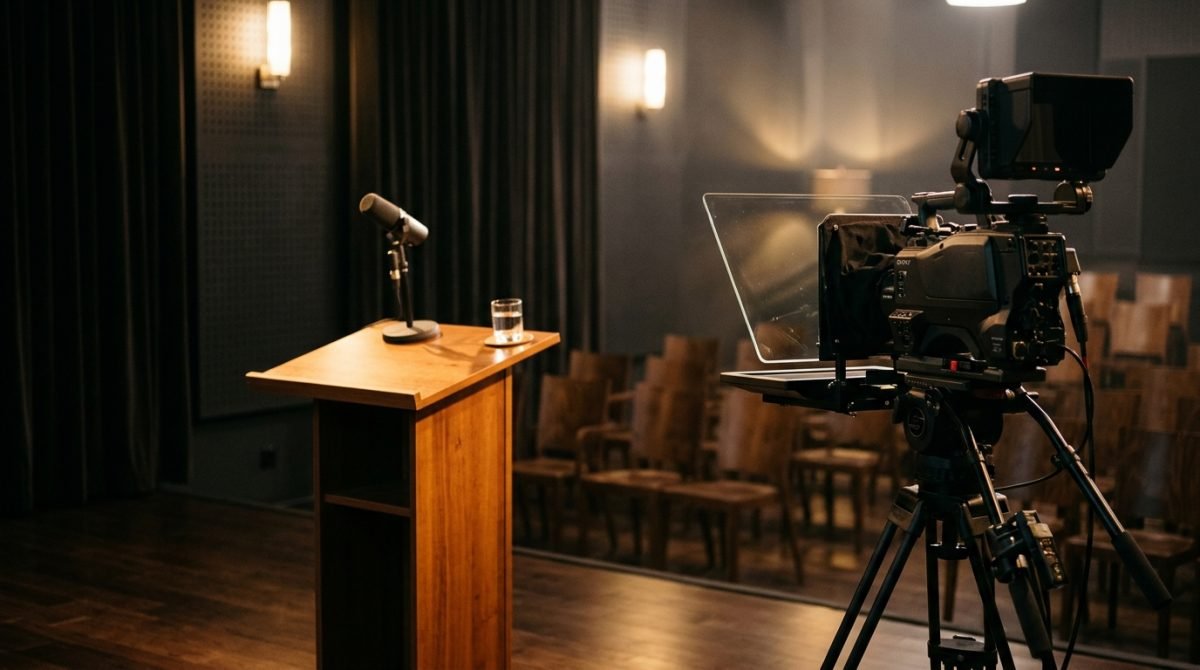
Friday afternoon, the autumn sun barely breaks through the conference room windows, and another manager stands in front of the lens, about to record a year-end summary for the board. The answer to how to speak to the camera without sounding like a robot comes down to one rule: the lens is not a text scanner, but the eye of your conversation partner. I see this regularly on film sets. The red light goes on, and the person who was freely joking over coffee a moment ago suddenly stiffens, holds their breath, and begins to recite. Working in front of the lens, on stage, during a defense, or at a job interview requires mastering specific mechanisms. Changing habits is a physical process, not a matter of mindset.
Before you stand in front of people
Autumn is a time for summaries. Presentations of results to boards, investor pitches, and project defenses are approaching. Some of them will take place in video format. Good preparation starts long before you hit record. Your body and voice need a warm-up, just like muscles before a workout.
- Write text for speaking, not for reading. The written word is governed by a different melody than the spoken word. Replace complex sentence structures with simple messages. Short sentences make breathing easier and impose a natural rhythm.
- Warm up your speech apparatus. A few minutes of humming, lip trilling, and gently massaging your jaw removes tension from your facial muscles. Your larynx must be loose for your voice to sound deep and stable.
- Set the frame at eye level. Looking from above or below changes the alignment of your neck, which affects your breathing path and how your posture is perceived. A camera set too low forces you to tilt your head and tightens your vocal cords.
- Prepare anchor points. Instead of memorizing every word, remember the structure of the story. Write down the three main thoughts you need to convey. Build the rest around them with the natural vocabulary you use every day.
How to speak to the camera step by step
The axis of the lens is your only point of reference. Many beginners look at the preview monitor, which creates the effect of shifting eyes on the recording. Focusing your eyes on the glass requires discipline. Imagine that one specific person is sitting behind that small lens. When you have a dialogue, you naturally maintain eye contact. Apply the same mechanism to the equipment.
The second issue is breathing. Stress makes us breathe shallowly, with the tops of our lungs. The voice then becomes squeaky, and we run out of air halfway through a sentence. Move your breath lower, to your diaphragm. This provides support for the sound and allows you to control the pace. You will feel it by placing your hand on your stomach. Your abdominal wall should rise when you inhale.
The third element is the pause. Silence in front of the camera seems to last forever, but for the viewer, it is a moment to process information. Stopping after a key sentence builds authority. It also allows you to take a calm breath and gather your thoughts before the next message. Sometimes it is hard to catch your own habits at home. A 1:1 training in the studio is a place where we work through one area on recordings, with me at the camera. You see the input material, we work sentence by sentence under the eye of the director, and then we record the output version.
Diction is another pillar. When you speak to the lens, you lack the natural feedback from another person. You start swallowing the endings of words. Pronounce voiced consonants with full engagement of your lips and tongue.
Most common mistakes
A stiff neck and lack of movement are the first signs of stress. The camera does not like statues. When you block your shoulder girdle, your voice loses resonance. The fix is to free your hands. Let your hands work in a natural range; a slight head movement and shifting your body weight are desirable. Gesturing helps maintain the rhythm of your speech.
Monotonous pace. Reading from a teleprompter or from memory often ends in a uniform rhythm. The sound blurs into one spot. The fix is sentence stress. Choose one word in the sentence that carries the most important information and slightly lengthen it. Slow down on hard data, speed up on anecdotes. Changing the dynamics keeps the listener's attention.
Wandering eyes while searching for a word. When you forget the text, your eyes automatically dart up or to the sides. The fix requires stopping. If you need to gather your thoughts, do it during a pause, without taking your eyes off the lens. Blink naturally at periods; this gives you a fraction of a second to reset. Shifting eyes lower the credibility of the message.
Poor air management. You start a sentence on a full breath and end on the last bits of air, which makes your voice dull and drop. The fix is breath planning. Take shorter, more frequent breaths at natural logical breaks. Do not try to say a whole paragraph on a single breath.
How to practice this
A home workshop does not require professional equipment. It requires regularity. Working with your body and voice is about building muscle memory. Here is a plan for the coming days.
Monday. Set your phone on a tripod at eye level. Record a minute of text, looking straight into the lens. Talk about what you did in the morning. Focus solely on keeping your eyes on one point. Do not judge the content; analyze only the contact with the glass.
Wednesday. Read the same text, but add a clear pause after every important word. Count to two in your head before you say the next sentence. Record it. At first, it will seem unnatural and slow to you. That is a good sign.
Friday. Watch both recordings without sound. Observe your face, neck tension, and eye movements. You will see a difference in how your posture is grounded. Your body in the second recording will be calmer, and your face more relaxed.
The camera exposes every falsehood, but it also rewards solid craftsmanship. Mastering these few mechanisms will make you start consciously controlling your message.
Questions and answers
Do I have to memorize the text before recording?
Memorizing often leads to stiff recitation and stress when you make a mistake. It is better to master the structure of your speech and the key anchor points.
What should I do when my throat gets dry in front of the camera?
Take a calm pause, take a sip of still, room-temperature water, and return to the axis of the lens. Short technical breaks are natural and do not ruin the reception.
How do I deal with a trembling voice?
Trembling comes from shallow breathing and larynx tension. Lower your breathing path to your diaphragm and consciously slow down your speaking pace.