How to Host a Sales Webinar: Structure and Time
Wondering how to host a webinar that holds attention? Discover the presentation structure, time management rules, and voice exercises.
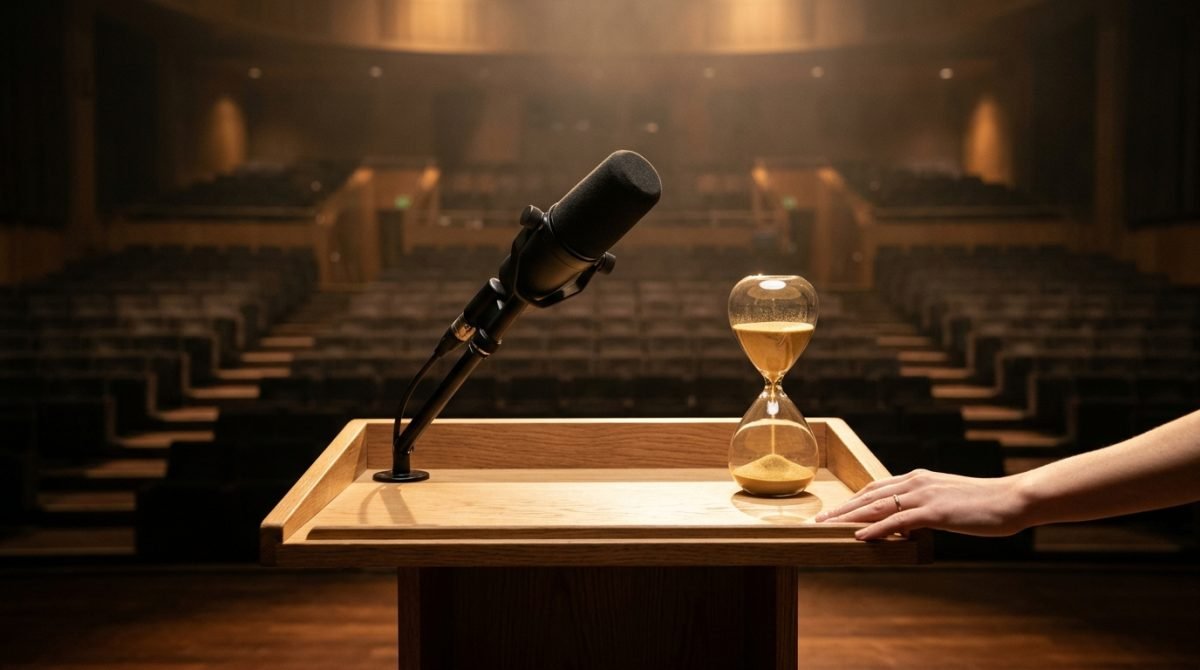
A Saturday autumn morning, it's gray outside, and you sit down at your computer to host an online meeting for several dozen people. The answer to the question of how to host a webinar comes down to two things: precise structure and iron time discipline. When I enter a television studio, I have a script in front of me calculated down to the second. You need a similar rigor on a webinar. The camera does not forgive chaos, and the attention of a viewer in front of a monitor escapes much faster than live in a conference room. That is why you need to know exactly what you will say in the first minute, and what in the fortieth.
Before you face the people
Before you click the broadcast button, you must master the space and your own body. I often see this on set when a guest sits in front of the lens and suddenly forgets to breathe. Stress makes your breathing shallow, and you can hear that in your voice right away. Preparation is a foundation that cannot be faked.
- Set the lens axis at eye level. Looking down builds unnecessary distance, and looking up distorts your face. Put books under your laptop if necessary.
- Warm up your vocal apparatus. A few minutes of humming and loose lip trills are enough to wake up your resonators. Relax your jaw.
- Divide your script into time blocks. Write down on a piece of paper next to the monitor at what minute you should start a specific segment. This is your private prompter with a schedule.
- Check the lighting. Your face must be evenly lit so the viewer can read your facial expressions. A window in front is a simple, very good light source.
- Prepare a glass of still water at room temperature. Cold water shrinks the vocal cords.
- Mute notifications on your computer and phone. The sound of an incoming email can throw you off your rhythm for a good dozen seconds.
How to host a webinar step by step
The presentation structure is a map for you and your listeners. We start with a strong opening. You have a dozen or so seconds to prove that you are worth listening to. Instead of talking about the history of your company, say what problem you will solve today. Outline the agenda. The viewer needs to know why they are investing their time.
Then you move on to the substantive part. The rule here is simple: one slide is one thought. People do not read walls of text on a screen. Focus on passing on specific knowledge using pauses. The pause is your main tool in voice work. It gives the listener time to digest the information, and you time to take a calm, diaphragmatic breath. Silence before an important sentence builds tension. Silence after it lets the punchline resonate.
Remember about voice modulation. Change your pace. Deliver important definitions more slowly, and tell real-life examples a bit faster. You only have your vocal apparatus and gestures at your disposal. Use your hands, but keep them in the frame, at chest height. Movements that are too wide blur the image.
The transition to the sales part requires fluidity. Do not suddenly change your tone of voice to an unnatural one. Treat the offer as an extension of the solution you were talking about a moment ago. Show specifics, parameters, and the process. Leave time for questions at the end. Time management means that if you promise a one-hour meeting, you end it after sixty minutes. The watch is your ruthless director. If you see that time is running out, shorten the anecdotes, not the key arguments.
The most common mistakes
When working with a camera and in front of a microphone, it is easy to stumble. Here is what I see most often on recordings and how to fix it.
Lack of eye contact. Looking at the participants' faces on the screen makes it look to them like you are looking down. Fix: look straight into the camera lens. That is where your viewer is. Stick a small, colorful sticky note right next to the lens to draw your eyes.
Too long of an introduction. A ten-minute lead-in puts people to sleep. Fix: say who you are in two sentences and go straight to the agenda. Leave your life story for another occasion.
Monotonous pace. Speaking in one breath and at a constant rhythm acts like a lullaby. Fix: emphasize the most important words in a sentence, slow down at key conclusions, speed up at lighter anecdotes. Play with dynamics.
Shortness of breath and cutting off word endings. Speaking too fast cuts off oxygen. Fix: take a breath in places where you would put a period in the text. Support your voice on your diaphragm.
How to practice this
Craft is built through repetition. I suggest a simple plan for the coming week that you can carry out at home, without specialized equipment.
On Monday and Tuesday, read your script out loud with a stopwatch in your hand. Check how much time it actually takes you to say the written words. We usually speak slower than we think, and stress additionally modifies the pace. Write down the times of individual blocks.
On Wednesday and Thursday, put your phone on a tripod and record five minutes of your presentation. Watch the footage without sound to evaluate your body language. Pay attention to what your hands are doing and whether you are rocking in your chair. Then listen to the sound alone, looking away from the screen, to catch monotonous fragments and diction problems.
On Friday, draw conclusions and make corrections to the text. Independent work with a phone gives you a solid foundation. However, if you feel that you need an outside eye and a professional environment, I invite you to a training session with me. In a Warsaw studio, with lighting, three cameras, and a prompter view, we work on your material. We record, analyze sentence by sentence, and repeat until you start to control every detail.
A good presentation is a craft that requires structure and time awareness. The rest is simply miles logged in front of the lens, which you have to cover step by step.
Questions and answers
How long should a sales webinar last?
The optimal time is about 45 to 60 minutes. That is enough to deliver value and present your offer without losing the viewers' attention.
How do you handle difficult questions live?
Always answer calmly and without rushing. If you don't know the answer, admit it and promise to return to the topic in a follow-up email.
Do I have to memorize the script?
No, reciting sounds unnatural and stiffens your body. Prepare a solid bullet-point outline and speak in your own words while sticking to the time frame.