Voice projection exercises: how to prepare for recording a course
Recording an online course? See how to prepare your vocal tract for working on camera. Discover proven voice projection exercises you can do at home.
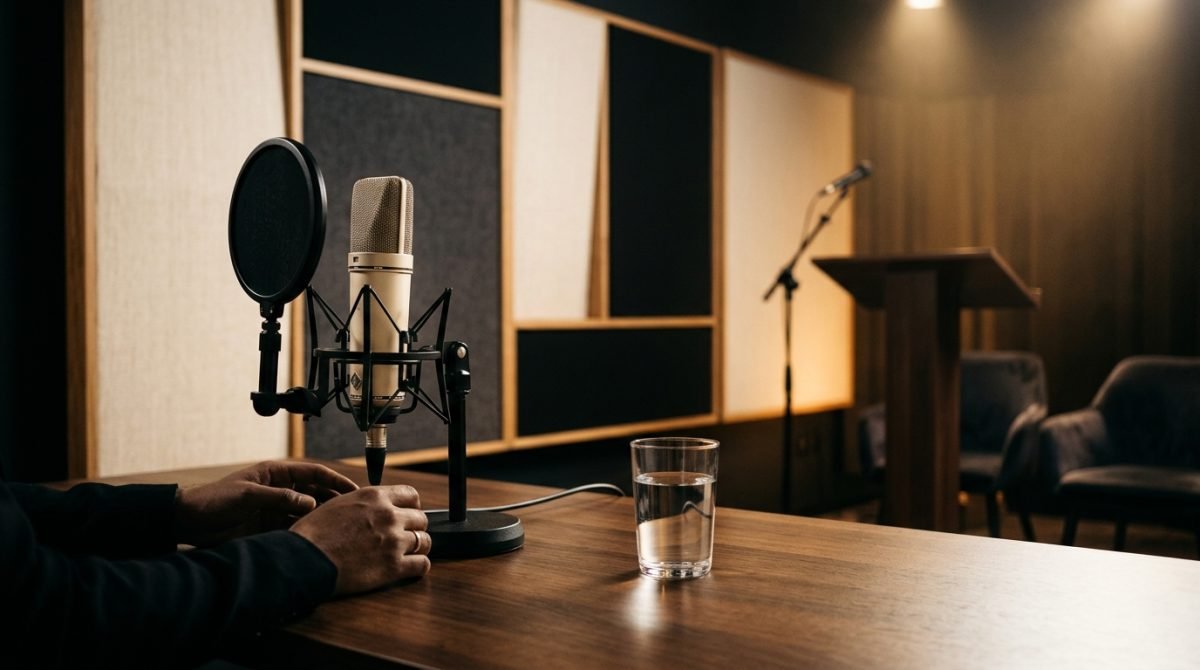
A Friday autumn morning on a film set. The red light on the camera turns on, and after the first sentence, the voice gets stuck in the throat. I know this scenario from many productions. Preparing the vocal tract for recording an online course requires a warmup, just like muscles before a long run. Before you start speaking to the lens, voice projection, breathing exercises, and the right mindset will help you maintain a steady pace and clear sound through many hours of work. Answering the question from the title: the vocal tract can and must be prepared for exertion to avoid hoarseness and losing your breath halfway through a module.
Before you stand in front of people
Recording a course is a marathon that requires a specific approach to your own body. On the air, we often speak in short segments, but in online production, you sit in front of the lens for several hours straight. Your vocal tract gets tired quickly if you do not take care of its foundations. Before you start recording and turn on the equipment, you need to check a few basic elements.
- Hydrating the body starts the day before. Water drunk right before the start only rinses the throat, but it does not properly hydrate the vocal cords. Drink regularly throughout the 24 hours preceding your entrance on set.
- Sleep is the foundation of a good sound. A tired body can be heard immediately in falling intonation, shallower breathing, and a lack of energy in the voice. You cannot hide sleep deprivation even with the best microphone.
- Relaxing the neck and shoulders is a step that many forget. Tension in these parts of the body automatically blocks the larynx and makes breathing shallower. Do a few head and shoulder rolls.
- Airing out the room where you are recording. Dry, warm air instantly dries out the mucosa, which leads to throat clearing and breaks in the recording.
Effective voice projection – exercises in front of the camera
Good voice projection, exercises, and a warmup are a regular part of my work in front of the lens. Before I say my first word, I perform a simple sequence that wakes up the vocal tract. You can do this at home or in the dressing room.
Step one is diaphragmatic breathing. Place your hand on your stomach, just below your ribs. Inhale through your nose so that your hand moves forward, and your chest remains still. Exhale slowly through your mouth, counting to six in your head. Repeat this ten times. This calms the heart rate and teaches you to control the airflow.
Step two is getting the resonators moving. Close your mouth and start humming, looking for vibrations on your lips and around your nose. Change the pitch of the sound, as if you were imitating a fire engine siren. The sound should vibrate in the front of your face, not in your throat.
Step three is working the articulatory system. Exaggeratedly and very slowly pronounce the vowels: A, E, I, O, U, Y. Stretch your lips, drop your jaw loosely. This removes tension from the facial muscles and makes your later diction much clearer.
Step four is a facial massage. With your fingertips, gently massage your cheeks, forehead, and jaw area. Reducing physical tension translates into speaking freely.
The most common mistakes
I see this often on recordings when we turn on the lights and the teleprompter. Stress amplifies bad habits that escape our attention in everyday conversation.
The first mistake is speaking on the last bit of breath. The sentence continues, there is a lack of air, but the speaker forces it to the period. The voice then becomes squeaky and unpleasant to the ear. The fix: take conscious pauses. A pause is a natural place to take in air and give the listener time to understand the content.
The second mistake is a clenched jaw. The sound has no way to resonate, words are flat, and the endings of words are swallowed. The fix: massage your temporomandibular joints before recording. While speaking, let your jaw drop naturally, especially on vowels.
The third mistake is drinking coffee and strong tea during recordings. These drinks dry out the mucosa and cause an unpleasant sticky feeling in the mouth. The fix: always have a glass of still water at room temperature on hand on set.
The fourth mistake is slouching in front of the lens. A sunken chest blocks the work of the diaphragm. The fix: sit on the edge of the chair, straighten your back, and pull your shoulder blades together. Your breath will immediately become deeper.
How to practice this
The vocal tract is a system of muscles that need regularity. You can train this yourself at home, building a simple habit.
Dedicate Monday and Tuesday to breathing. For five minutes in the morning and five minutes in the evening, lie on your back with a thick book on your stomach. Observe how it rises on the inhale and falls on the exhale. This teaches the body the correct breathing pattern.
Wednesday and Thursday are time for diction. Read any text out loud for ten minutes while holding a pencil or a cork in your teeth. Try to be as understandable as possible. After removing the obstacle, read the same segment. The difference in the lightness and precision of speaking will be felt immediately.
Friday and the weekend are for working with your phone camera. Record short, one-minute statements on any topic. Pay attention to where you take a breath and whether your voice weakens at the end of a sentence. Your own recording is raw material for analysis. When you feel that home methods are not enough, training in a working production studio in Warsaw—with professional cameras, a teleprompter, and a director on set—makes a huge difference. Recording right at the start, working on the material, and getting sentence-by-sentence feedback allow you to break through blocks that you cannot see in a mirror at home.
Recording an online course becomes much easier when your voice cooperates with your intentions. A well-warmed-up vocal tract means greater working comfort for you and a much better experience for your listener.
Questions and answers
Does lemon water help before recording?
Citrus fruits can irritate and dry out the throat mucosa. The best thing for hydrating the vocal tract is plain, still water at room temperature.
How long should a vocal warmup take?
Fifteen minutes of focused work before stepping onto the set is enough. The accuracy of the breathing and articulation exercises is more important than the length.
What should I do if my throat gets dry during a recording?
Stop the take, drink some water, and take a few deep diaphragmatic breaths. Recording a course gives you the comfort of always being able to repeat a given segment.