First Seconds of a YouTube Video: How to Speak at the Start
See how to use the first seconds of a YouTube video to retain the viewer. Learn specific speaking and voice techniques right from the start.
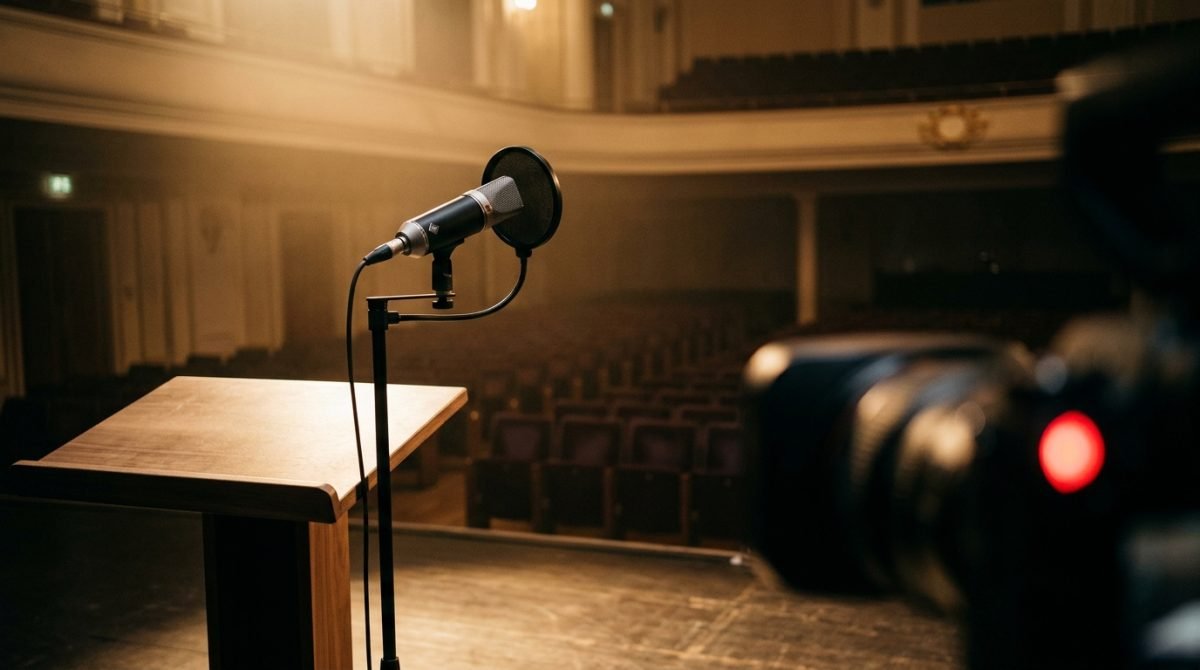
An autumn Saturday morning is a moment when web traffic slowly grows. Viewers sit down with coffee, scroll through apps on their phones, and lazily click on thumbnails. They start a video, look at the host, and in a fraction of a second make a decision about whether to keep watching. The thumbnail and title are not everything, because retaining attention is ultimately determined by the first seconds of a YouTube video. So how should you speak at the start to avoid losing the viewer? The answer is: start with specifics, maintain constant eye contact with the axis of the lens, and consciously use a pause before the most important word.
Before you stand in front of people
Before you turn on the camera in your room or step onto a film set, you need to prepare your speech apparatus and your mind for work. I see this often during test recordings in the studio. The host has a well-written topic, but starts speaking on the remnants of a breath, which makes their voice sound flat and uncertain. Preparing for the first thirty seconds requires precision and a technical approach to your own body.
- Define the viewer's main problem in one simple sentence, avoiding complex, compound structures.
- Write down the first three sentences of your presentation word for word to avoid searching for thoughts at the start.
- Position the camera or phone so that the lens is exactly at your eye level, which prevents unnatural head tilting.
- Take a calm, deep diaphragmatic breath a few seconds before you say the first word.
- Ensure a stable posture by resting your body weight evenly on both feet, without locking your knees.
- Do a short warm-up of your speech apparatus by clearly pronouncing a few difficult consonant clusters.
These are the foundations that allow the body to understand that we are starting work in front of the camera. If you skip this stage, stress and muscle tension will immediately reflect in the sound of your voice.
The first seconds of a YouTube video step by step
When the red light turns on on set, there is no time for a run-up and searching for the right words. The first seconds of a YouTube video are the moment when you have to prove to the viewer that you are in control of the topic. We start with the axis of the lens. The camera glass is the eye of your interlocutor. If you look away to the sides in search of thoughts, you give the impression of an unprepared person. Look straight into the center of the lens throughout the entire first sentence, without blinking nervously.
The next element is intonation and sentence stress. In the Polish language, we have a natural tendency to drop our tone at the end of a sentence. In the first words of a recording, however, we need energy that will hold the listener's attention. Choose one key word in the first sentence and gently emphasize it by slightly raising your tone or slightly lengthening the vowel. This gives the statement rhythm.
Right after it, use a pause. Silence in front of the camera seems to last forever to the host, but for the viewer, it is a clear signal that you control the situation. A pause gives the audience time to process the information they heard. During the Master of YouTube training, where we work on your channel for two days on content, publishing, broadcasting, analytics, and monetization, we often analyze this mechanism on recordings. I observe there how implementing a simple, one-second pause after a strong first sentence drastically changes the reception of the entire material.
The pace of speaking is also important. Out of nerves, we often speed up, wanting to convey as much content as possible in the shortest possible time. The effect is usually the opposite of what was intended. Diction becomes sloppy, word endings disappear, and breathing becomes shallow. Start speaking a bit slower than what seems natural to you for an everyday conversation.
Most common mistakes
On recordings, several patterns regularly repeat that effectively discourage audiences in the first moments. It is worth identifying and eliminating them already at the stage of home rehearsals.
The first mistake is a long greeting and a detailed introduction of yourself. Starting with words about who you are, what you do, and what today's episode will be about is wasting the viewer's most valuable time. The fix is to reverse this order. Start with a specific thesis, problem, or question, and only after a dozen or so seconds weave in a short introduction of yourself.
The second mistake is wandering your eyes over the preview screen. Instead of the lens, the host looks at themselves on the flip-out camera screen or on the phone monitor. For the viewer, this means the speaker is looking somewhere to the side or down. The fix is technically simple, although it requires developing a new habit. Tape over the preview screen with painter's tape while recording the intro and look exclusively into the dark glass of the lens.
The third mistake is a flat, monotonous voice devoid of dynamics. It usually results from reading from a teleprompter without previously preparing the text for speaking. The sentences are too long, and the breath is shallow. The fix requires shortening sentences already at the scriptwriting stage. Text meant for speaking must breathe. Leave room in it for periods where you can freely take in air.
The fourth mistake is nervous, uncontrolled body language. Shifting from foot to foot, excessive hand gestures, or completely stiffening the shoulder line. The fix is to consciously ground your body in space. If you are standing, plant your feet into the ground hip-width apart. If you are sitting, rest your back and place your hands on the tabletop, allowing them a natural, economical movement within the frame.
How to practice this
The skill of opening recordings is a craft based on muscle memory. It requires regularity and a cold analysis of your own mistakes. I propose a simple plan for the coming week that you can carry out in your own home using a smartphone.
From Monday to Wednesday, record only the first thirty seconds of your presentation with your phone. Choose three different topics from your field. Do not record the rest of the material. Focus only on how you enter the topic, how you stand, and how your first sentence sounds. Do five takes each day.
On Thursday and Friday, sit down with the collected video material. Watch all the recordings without sound. Pay attention to whether your eyes are directed at the lens, whether your posture is stable, and whether your facial muscles reveal tension. Write down technical conclusions on a piece of paper.
On the weekend, watch the same materials with the sound on. Listen to your pace, diction, and the moment you take a breath. Check if you make pauses exactly where you planned them earlier.
At home, you will practice the text, posture, and the basics of breath support. Training in the studio makes a difference when you need to test yourself in multi-camera conditions, with a professional teleprompter and lighting. Then on set, in real time and sentence by sentence, we correct every detail until the mechanics of speaking become a habit.
A good start in front of the camera is a matter of technique and mastering a few repeatable variables. The rest depends on how diligently you work through this process in front of your own lens.
Questions and answers
Do I always have to write a script for the first seconds of a video?
Yes, writing out the first three sentences word for word gives you confidence at the start. This allows you to avoid stuttering and searching for the right words when the recording starts.
Where should I look when recording a video with a phone?
Always look exactly into the camera lens, not at the center of the screen. This is the only way to build direct eye contact with the viewer on the other side.
How do I deal with a shaky voice at the beginning of a recording?
A shaky voice comes from shallow breathing and larynx tension. Before starting, take a deep diaphragmatic breath and start speaking on a conscious exhale, slightly slowing down your pace.