Pitch Deck Presentation: How to Speak to Investors
A pitch deck presentation is more than just slides; it's your voice and body. Learn how to prepare for the camera and read from a teleprompter naturally.
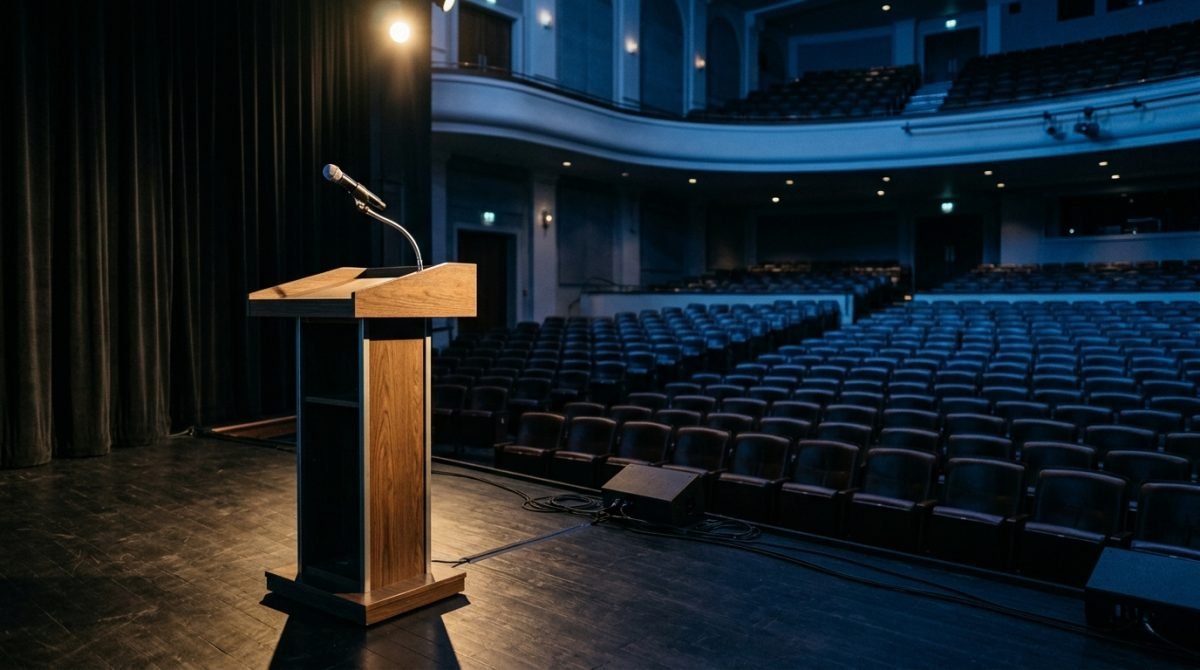
It is a Sunday autumn morning, and we are setting up the lights in the studio for another recording. A startup founder drinks water and quietly reviews his notes before his first presentation for a fund. A good pitch deck presentation is not about modern slide graphics, but about how your body and voice can carry that message.
Before you stand in front of people
Preparation starts long before the camera turns on or you step on stage. I see this regularly on set, when a text written in the office collides with the vocal apparatus. The written word has a completely different density than the spoken word. When you read your script in your head, your brain automatically ignores the lack of breath. When you start speaking out loud, you run out of air mid-sentence. Your text must be translated into spoken language.
- Reduce the content by crossing out unnecessary adjectives and adverbs, leaving strong verbs and nouns.
- Split long, complex sentences into two or three shorter ones.
- Mark places to breathe by putting a simple vertical line in the text, which will remind you of the physical need to take a breath.
- Read the whole thing out loud while walking around the room, and if you stumble anywhere, immediately change that word to a simpler one.
- Format the text for reading by enlarging the font and bolding key numbers where you need to slow down.
Writing for speaking is a craft. Before you stand in front of the lens, your vocal apparatus must know this text on a muscular level. It is not about memorizing, but about getting used to the rhythm of the sentences.
Pitch deck presentation step by step
When you stand in front of the lens, you have to connect the content with body language. This is where equipment often appears, which is supposed to help, but if you are not used to it, it can get in the way. Reading from a teleprompter: sentence stress, pause, interpretation - you sound like yourself. It is a process that requires awareness of your own voice and body. In the Warsaw studio, we work on this using three cameras, broadcast microphones, and a professional screen, but you can understand and implement the mechanics yourself.
First, body positioning builds your authority. Feet spread hip-width apart provide physical stability. Your body weight should be distributed evenly on both legs. When you stand firmly, your breath automatically goes lower, to the diaphragm. This makes the voice fuller and stops it from trembling in stressful moments.
Second, eye contact. The camera lens is the eye of your conversation partner, and in this case, the investor. If you read from a teleprompter, the text scrolls on a glass placed at an angle in front of the lens. Your eyes must take in the entire line, and your head should remain still. Standing too close to the camera will make the viewer clearly see your eye movement from the left to the right edge of the screen. The optimal distance is one where the lens frames you from the waist up, which we call the American shot.
Third, hands. The frame limits the space where your gestures are visible. Keep your hands above your belly button line. Let them work naturally, but avoid sudden movements that will draw attention away from your face. Gestures should emphasize the most important points, not serve as a background for every spoken word.
Most common mistakes
From the perspective of a director on set, I see recurring patterns. A body under stress reacts similarly in most of us, regardless of business experience.
The lack of a pause is the most common problem. Out of fear of silence, people glue sentences together into one long string. They speak on a single breath until their larynx completely tightens. The fix relies on a physical stop. After a period, close your mouth and take a short breath through your nose. Silence on camera feels like an eternity, but for the listener, it is the necessary time to understand your numbers.
Wandering eyes reveal uncertainty. When you search for a thought or recall the next slide, you look at the ceiling or to the sides. On camera, this looks like a lack of preparation. The fix is simple. If you need to think, look straight into the black eye of the lens. Maintaining eye contact in a moment of thought builds trust.
Tense shoulders are a physiological reaction to stress. It raises the shoulders to the ears, which shortens the neck and blocks the free flow of air through the larynx. The voice then becomes flat and high-pitched. The fix requires intervention before starting. Take a deep breath, raise your shoulders as high as possible, and with a loud exhale, drop them loosely down.
The wrong lens height destroys the relationship. Looking down at a laptop camera gives the face an expression of arrogance, and looking up makes you look dominated. The fix is always setting the lens exactly at your eye level.
How to practice this
On-camera training is an iterative process. The method I use is an initial recording, working on the material, and a final recording. Sentence-by-sentence feedback allows you to quickly eliminate mistakes. I accept applications for such sessions through the form on my website, but before you decide to work in the studio, do some solid training at home. Spread it out over the whole week.
Dedicate Monday to working with the text. Write a short, one-minute introduction to your presentation. Print it, cross out difficult words, and clearly mark the pauses.
Tuesday is time for technique. Install a free teleprompter app on your phone or tablet. Set the appropriate font size that will allow you to read without squinting, and adjust the scrolling speed to your natural speaking rhythm.
Wednesday is the first clash with the lens. Prop your phone against a stack of books, making sure the lens is at eye level. Stand a meter away, start recording, and read the text out loud.
Thursday requires analysis. Watch yesterday's recording without sound. Pay attention to what your hands, shoulders, and eyes are doing. Then turn the phone over and listen to the sound alone. Check if the periods are audible and if you stress the most important words.
Friday is time for correction. Repeat the recording, but focus on eliminating just one mistake that stood out the most yesterday. Do not try to fix everything at once.
Saturday is a test in conditions close to real ones. Say the same text live, standing in front of a household member. See how the presence of another person changes your breathing and stress level.
The camera is just a recording device. It records exactly the state of preparation you have when you stand in front of it. Solid skills and multiple rehearsals allow you to forget about technique and focus on the value you want to convey to investors.
Questions and answers
Can you tell someone is reading from a teleprompter on video?
A proper distance from the lens and narrow text formatting make eye movement unnoticeable. The key is to take in the entire line with your eyes without moving your head.
How long should a pitch deck text be?
On camera, texts based on short sentences with more verbs than adjectives work best. One standard manuscript page equals about two minutes of calm speaking with appropriate pauses.
What should I do if I lose my place on the teleprompter?
Pause, take a calm breath, and wait for the operator to stop the text or scroll it to the right spot. You can always do another take, and silence makes editing easier later.