Solo Video Podcast: How to Speak to Camera Without a Guest
A fall evening is a great time to start a podcast. Learn how to prepare a script and speak to the camera when there's no guest in the studio. Practical steps.
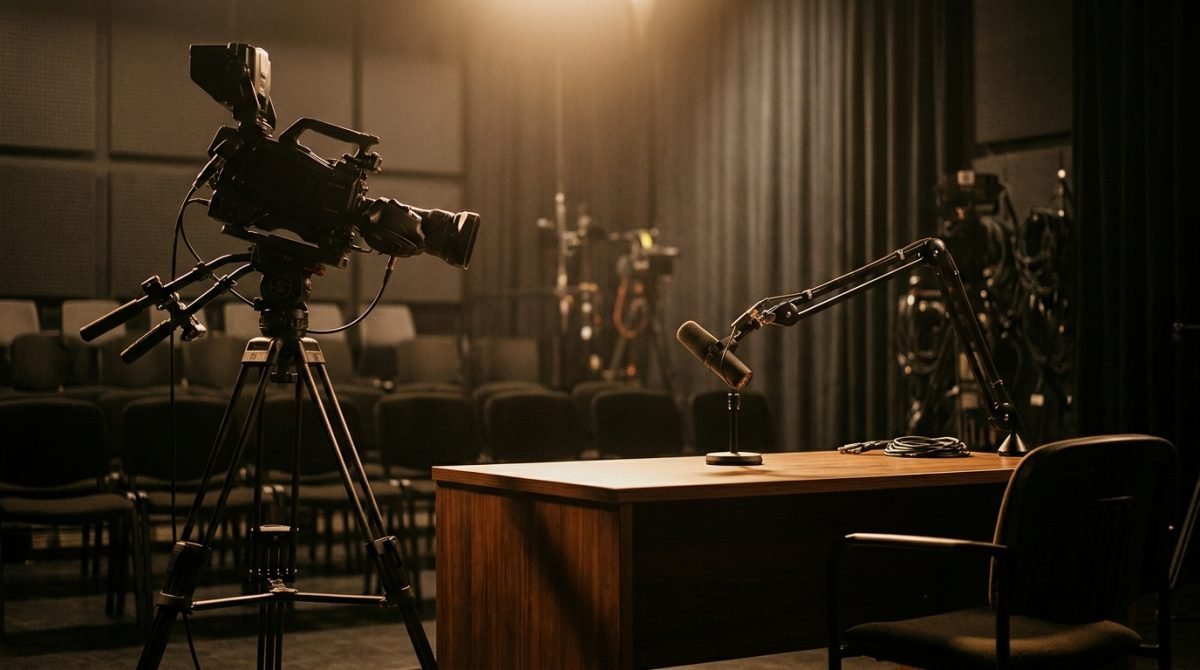
A fall Friday evening is a time when we calmly plan new projects. If you are thinking about your own video format without a guest, you are probably wondering how to speak to the camera for several dozen minutes without putting the viewer to sleep. A solo podcast requires precision because no one will save you with an anecdote during moments of silence. The answer comes down to the structure of the text and the awareness of your own voice.
Before you stand in front of people
When the lights go down on a television set and the text appears on the teleprompter, there is no time left to invent punchlines. Everything must be ready beforehand. In a solo podcast, you are the producer, scriptwriter, and host all at once. Preparation is the foundation. Before you press the record button, you need to know where you are going.
- Build a narrative axis. Instead of writing down every word, list five main points you want to guide the listener through.
- Prepare the opening. The first thirty seconds determine whether someone will stay with you longer. Write it down word for word and memorize it.
- Write for speaking. Turn long, complex sentences into short messages. Throw out difficult words that might twist your tongue.
- Plan your pauses. Mark the places in your notes where you will take a breath. Give the viewer time to digest the information.
- Take care of the technical conditions. Check the frame, the lighting setup, and make sure the microphone is picking up your voice, not the echo from an empty room.
Step by step: how to speak to the camera in a solo format
Sitting alone in front of a lens can be unnatural. You don't have a living person in front of you nodding in understanding. You have to imagine this receiver on the other side of the lens. Over time, this piece of glass becomes your conversation partner.
Look into the center of the lens. That is where your viewer is. Looking away toward the screen monitor makes you lose contact with the audience. The axis of the lens is the only place where you establish a relationship. When you are telling a more difficult story, look straight into the lens and hold your gaze there a little longer.
Use your hands, but in moderation. Gesturing helps emphasize the most important thoughts. Keep your hands in the frame, at chest height. Avoid nervously adjusting your clothes or touching your face. Let your hands work to the rhythm of your words. When you explain a process, show it with movement.
Work with pace and volume. Monotony is the biggest enemy of solo podcasts. Speed up when you talk about something lighter or tell an anecdote. Slow down and lower your voice when you provide key data. Place sentence stress on the words that carry the most meaning. Your voice is a tool that gives dynamics to the entire recording.
Breathe with your diaphragm. Shallow breathing from the chest makes your voice high and tense. A deep breath allows you to lead a phrase freely. Before you start speaking, take a calm breath into your lower ribs.
Remember your facial expressions. Your face is your primary tool of expression. A gentle smile at the beginning of the recording breaks the distance. You don't have to smile throughout the entire episode. It is enough for your eyes to be engaged in what you are saying. The camera catches any boredom with the material.
Most common mistakes
In recordings, I often see patterns that repeat regardless of the speaker's experience. Working with a camera quickly verifies habits.
The first mistake is reader syndrome. Instead of telling a story, you read from a piece of paper or a screen with a flat voice. You lose the natural melody of speech. The fix is to take your eyes off your notes. Treat the outline only as a roadmap. Tell the story in your own words, using everyday vocabulary.
The second mistake is a lack of breath. You want to say as much as possible on a single exhale. Because of this, you run out of air at the end of the sentence, and your voice weakens. The fix is simple. Use a period. Take a breath before each new paragraph. Allow yourself a second of a break.
The third mistake is a stiff posture. You sit locked in your shoulders, which is immediately heard in your voice. A tense body means a tense speech apparatus. The fix requires movement. Before turning on the recording, do a few arm circles. Sit on the edge of the chair and rest your feet flat on the floor. Feel the stable support.
The fourth mistake is looking up. When you search for a thought, you look at the ceiling. On camera, this looks like a lack of confidence. The fix is to maintain contact with the lens even when you are thinking about the next word. Pause, but do not break eye contact.
How to practice this
On-camera skills are built through repetition. You can start this process in your own living room. You don't need expensive equipment for this.
The plan for this week is simple. Every morning, turn on the camera on your phone. Tell the lens about one event from the previous day or summarize an article you read. Speak for exactly two minutes. Do not stop the recording, even if you make a mistake. Then watch the footage. Pay attention to where your eyes wander, whether you take pauses, and how your voice sounds. Write down one thing to improve for the next day.
Pay attention to diction. At home, you can practice the clear pronunciation of consonants. Read a page of a book out loud, intentionally exaggerating the articulation. This way, you will warm up your facial muscles, lips, and tongue. You will see the difference in your next recording.
When you feel that home methods are not enough, it is worth testing yourself in professional conditions. Training with me in a Warsaw studio allows you to see yourself from the perspective of three cameras, feel the lighting, and hear your voice from a broadcast microphone. We work on the recorded material, sentence by sentence, until your speech apparatus and body start working together naturally.
A solo podcast is a format that exposes your technique, but it also gives you full control over the message. It requires discipline, but with every recorded episode, the lens becomes more and more familiar.
Questions and answers
Do I have to write the entire podcast script word for word?
No, unless you are using a teleprompter. A detailed outline with a clearly written beginning, key points, and a strong ending is enough.
What should I do if I make a mistake during recording?
Take a longer pause, take a calm breath, and repeat the entire sentence from the beginning. This will make later editing easier without jumpy cuts.
How long should a solo video episode be?
As long as you have substantial material for. It is better to record a dense, specific fifteen minutes than to artificially stretch the topic to an hour.