How to Prepare for a Conference Presentation in 4 Weeks
The fall industry season is fast approaching. Learn how to plan your conference presentation prep, master your voice, and avoid mistakes on stage.
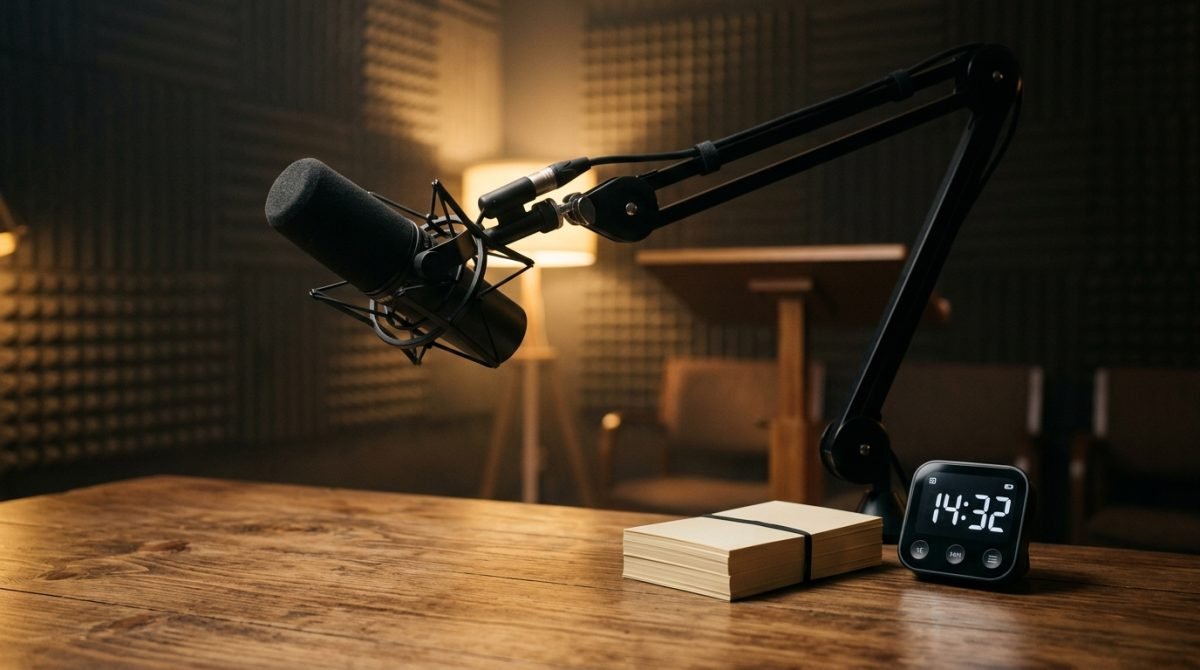
Sunday morning is a good time to look at the calendar. Fall is approaching, and with it starts the season of industry meetings, panel discussions, and presentations. Effective preparation for a conference presentation takes time, which is why four weeks is the optimal buffer to master the material and your own body. When I step onto a stage or into a television studio, I rarely improvise from scratch. True ease comes from a solid foundation. The audience in the room quickly figures out who has done their homework and who is counting on a stroke of luck.
Before you stand in front of people
Before you start arranging slides in a graphic design program, you need to know exactly who you are talking to. On a film set, I always ask the producer who is watching us at that moment. On a business stage, the rule is exactly the same. Your story must address the specific needs of your listeners. Start your preparation with a cool analysis of the situation.
- Define one main takeaway that the listener should leave the room with after your lecture.
- Check the technical conditions: whether you will get a handheld microphone, a lavalier microphone, or if you will be speaking from behind a lectern.
- Determine the exact time you have available, and plan your material to be ten percent shorter to have a margin of error.
- Get to know the space, ask the organizer about the size of the stage, the type of lighting, and the distance from the front row.
- Pay attention to the time of your presentation, because speaking right after a lunch break requires different energy than opening a morning block.
Solid preparation for a conference presentation
Spreading the work over four weeks helps you avoid panic the day before the event. Week one is working on the text. Writing for speech differs drastically from creating a blog article. Use short sentences. Give up complicated interjections and industry jargon, leaving in the script only those difficult words that cannot be replaced with a simple equivalent. When you read your draft out loud and run out of breath, it is a sign that the sentence is too long. Split it into two smaller ones. Pay attention to sentence stress. In written language, we emphasize the importance of words with bold text, but in speech, we do it with our voice, accentuating the most important word in the sentence.
Week two is conscious breathing and voice. Stress makes your breathing shallower, which makes your voice squeaky, quiet, and uncertain. Many speakers breathe shallowly, raising their shoulders. This is a mistake. Practice diaphragmatic breathing. Place your hand on your stomach, inhale through your nose so that your stomach pushes your hand out, and then slowly release the air through your mouth. Do this every day for a few minutes. This is a mechanism that stabilizes the larynx and lowers the tone of your voice.
Week three is body and eye contact. On stage, your movement matters immensely. If you are standing, stand firmly on both legs. Avoid shifting your weight from foot to foot, because it reveals nervousness and distracts the viewer. Also, take care of your hands. Do not hide them in your pockets and do not cross them on your chest. Keep them at waist level, using open gestures. Find three imaginary points in the audience: on the left, in the middle, and on the right. Shift your gaze between them, stopping it for a few seconds on specific faces.
Week four is rehearsals and polishing your form. Record yourself with your phone. Watching yourself on screen can be difficult, but it allows you to catch habits you have no idea about. If you feel you need outside support and an objective eye, a comprehensive public speaking workshop will work well: message construction, opening, punchline, and controlling stage fright. In my Warsaw studio, we work on a live organism. We record your practice take, analyze the material sentence by sentence, and repeat it until it starts coming out naturally. Three cameras, studio lighting, and broadcast microphones quickly verify what you have practiced at home.
Most common mistakes
From my practice in front of the camera and observation of training participants, it turns out that certain slip-ups repeat regularly in most speakers.
Memorizing the text. When you forget a single word, the whole structure falls apart, and your mind goes blank. Instead, memorize the structure, the order of arguments, and keywords. Talk about your topic, do not recite a learned poem.
Lack of pauses. Silence on stage is your most important tool, not your enemy. It gives listeners time to digest an important thought, and gives you a moment for a calm breath. Mark the places in your notes where you will intentionally stay silent for two or three seconds.
Overloaded slides. The presentation is a background for you, not a teleprompter you read from. If there is a wall of text on a slide, the audience will start reading it and stop listening to you. Leave only keywords, numbers, or images there.
Avoiding eye contact. Looking at the ceiling, at your own shoes, or at the screen with slides builds an invisible wall between you and the audience. When you speak to a camera, you look for the axis of the lens. In a conference room, you look for the eyes of specific people.
How to practice this
You can put together a simple training plan in your own living room, without using specialized equipment. On Monday, read your draft out loud, recording just the audio with the voice recorder on your phone. On Tuesday, listen to it during a walk, looking for places where you lose your rhythm or stumble over difficult words. On Wednesday, put your phone on a tripod and record a video, speaking from memory, using only your outline. On Thursday, watch this recording without sound, observing only your hands, facial expressions, and posture. On Friday, ask someone close to you to listen to you for five minutes and let you know if the main takeaway from your speech is clear to them.
Home exercises effectively build basic body and voice awareness. However, when you care about full precision and mastering the details, working in a professional studio makes a difference. There is no room for guesswork there, because the screen immediately shows how the viewer perceives you, and the director ensures conditions similar to a real stage.
The stage always verifies the preparation stage, but it also forgives minor slip-ups if you can maintain contact with the audience. Focus on the value you want to convey, and technique will be your silent support.
Questions and answers
How long does it take to prepare for a presentation?
The optimal time is four weeks. This allows you to calmly write the text, master your breathing, and rehearse multiple times on camera.
How do you deal with a shaky voice on stage?
The key is diaphragmatic breathing. A conscious, deep breath stabilizes the larynx and makes your voice sound more confident.
Should you memorize your presentation?
Definitely not. It is better to memorize the structure and keywords, which allows for natural storytelling and protects against your mind going blank.