YouTube: How to start speaking to a camera and read a prompter
Wondering how to start speaking naturally to the camera when recording for YouTube? Discover techniques for working with text, a teleprompter, and the lens.
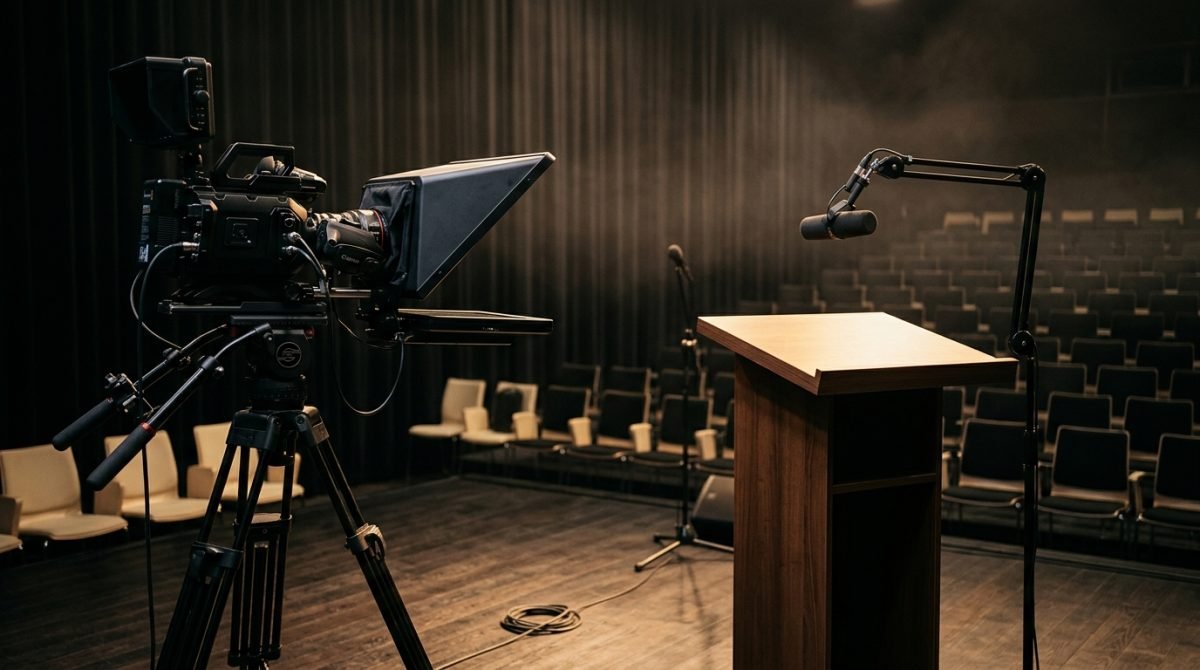
A Thursday autumn morning is usually a time of analysis for me. I am currently reviewing raw footage from yesterday's studio session and I see the exact same recurring pattern. A grown, competent person steps in front of the lens, the red light goes on, and all the air leaves them. They start to stiffen their neck, their voice becomes flat, and their eyes dart away looking for a rescue. If you are planning your YouTube channel and wondering how to start speaking to the camera, the answer is simple, though it requires work. Stop playing a presenter and start telling a story to one specific person. The camera does not need your acting version. The camera needs your truth, delivered in a technically correct way.
Before you stand in front of people
The camera exposes every lack of preparation. Before you hit record and stand in the lights, you need to know exactly where you are going with your message. I do not show shortcuts that will make you speak like a news anchor after one day. I also do not promise that you will get thousands of subscriptions after one recording. I teach a craft, and writing a script, setting up the lighting, and warming up your vocal apparatus are the foundation of this trade. A text written to be read silently rarely works in front of a lens.
- Build an ironclad structure. Write down the three main points you want to convey and stick to them while speaking.
- Write a text meant to be spoken. Use short sentences, everyday vocabulary, and avoid multiple complex structures where you will get lost.
- Read your script out loud in the room. If you run out of breath halfway through a sentence, it is a sign that the sentence is too long and needs a period.
- Imagine the receiver on the other side. Build an image in your head of one person you are directing these words to, which will naturally lower your tone of voice.
YouTube: how to start speaking to the camera step by step
Working with a lens is a technique that can be mastered. When you look into the black lens of a camera, your brain gets no feedback. There is no nodding, no smiling, no eye contact that we are used to in everyday conversations. That is why you have to trick your own head. Instead of seeing equipment, imagine that behind this glass sits a good friend to whom you are explaining a complex problem.
If you use a prepared text, reading from a prompter becomes crucial. During my training sessions in the Warsaw studio, I often see how the scrolling text completely takes control of the speaker. The person starts chasing the letters. The art lies in mastering this. Sentence stress, a conscious pause, and your own interpretation of the text are tools that make you sound like yourself. The prompter should follow you, not you the prompter. Once you master this skill, the viewer will not even notice that you are using a script.
Look straight into the axis of the lens. Do not look away to the sides or glance nervously at the preview screen. Eyes reveal every uncertainty. Maintaining constant eye contact with the camera builds an invisible bond with the viewer on the other side of the screen. When you look away, you break that connection.
Most common mistakes
I have seen hundreds of mistakes on set. They usually stem from physical tension and bad habits that we bring from everyday life. The camera acts like a magnifying glass and exaggerates each of them.
Shallow breathing is the number one problem. You start speaking on the last bits of air, which makes your voice flat, high, and devoid of resonance. The fix is physical. Before the first word, take a calm, deep breath with your lower ribs, activating your diaphragm. Let the air carry your voice.
Monotonous reading kills the viewer's attention. You focus on reading the next words and lose the whole meaning of the statement. The fix requires text analysis. Look for the most important word in every sentence and put the stress on it. Treat the rest as background. A pause before an important word builds tension and gives the viewer time to process the information.
A stiff posture blocks the flow of energy. You tense your shoulders, stiffen your neck, and look like a statue. The fix starts from the feet. Stand with your legs slightly apart, shift your body weight evenly to both legs. Let your hands gesture naturally at waist height. Hand movement helps in naturally accentuating words.
Wandering eyes are an escape from confrontation. You glance at the ceiling looking for a thought, or you look at your hands. The fix relies on discipline. Before you start speaking, find the center of the lens. Fix your eyes there and hold them for as long as your thought lasts.
How to practice this
On-camera skills are built exclusively through repetition. You can start this process in your own home, without investing in expensive equipment. Build a plan for the coming days.
On Monday, write a short text for exactly one minute of speaking. On Tuesday, read it out loud a dozen times, looking for a natural rhythm, places to breathe, and pauses. On Wednesday, set your phone on a tripod, hit record, and say this text while looking straight into the small lens. On Thursday, watch this recording without sound. Evaluate your body language, check if you are swaying side to side, and if your eyes are darting away. On Friday, turn the phone over and listen to just the audio. Pay attention to whether your voice sounds confident and if you are making pauses.
Home exercises provide a solid foundation and allow you to get used to your own image. However, there comes a moment when a phone in the living room is not enough. Training in a working production studio makes a difference. Three cameras, studio lighting, broadcast microphones, and a director on set allow you to confront real conditions. My method is based on facts. We do an entry recording, work on the material sentence by sentence, and then do an exit recording. We iterate until you get it right.
The camera is just a tool that records reality. It is up to you whether you show it a tense reader or a person who has something important to say.
Questions and answers
Do I have to memorize the text?
No. It is better to speak from your own bullet points or use a teleprompter correctly, maintaining a natural accent and pauses.
How do I deal with a dry throat before recording?
Drink still water at room temperature an hour before you start. Avoid coffee and strong tea, which dry out the mucous membrane.
Where should I look when recording a video with a phone?
Always look straight into the small lens, not at your face on the screen. Only then does the viewer feel like you are looking them in the eyes.